The global shift toward sustainable infrastructure has placed a spotlight on the grp pipe production line as a cornerstone of modern fluid transport. Glass Reinforced Plastic (GRP) pipes offer an unparalleled combination of corrosion resistance and structural strength, making them indispensable for water treatment, chemical processing, and oil and gas sectors. By integrating advanced filament winding and pultrusion technologies, these production lines enable the creation of piping systems that outlast traditional steel and concrete alternatives.
From an industrial perspective, the efficiency of a grp pipe production line directly impacts the scalability of environmental protection projects. As cities expand and industrial zones face stricter wastewater regulations, the demand for high-performance, non-corrosive piping has surged. Understanding the technical nuances of these production lines—from resin impregnation to precise curing cycles—is essential for stakeholders looking to optimize operational costs and ensure long-term infrastructure reliability.
Ultimately, investing in a high-quality grp pipe production line is not just about manufacturing capacity; it is about contributing to a greener planet. By reducing the frequency of pipe replacements and eliminating the risk of soil contamination from rusted metal pipes, GRP technology aligns perfectly with global ESG (Environmental, Social, and Governance) goals. This guide explores the technical architecture, global applications, and future innovations driving this critical sector of specialized equipment manufacturing.
Global Relevance of GRP Pipe Production Lines
In an era defined by rapid urbanization and the urgent need for water scarcity solutions, the grp pipe production line has emerged as a vital technological asset. According to industry trends aligned with ISO standards for composite materials, the transition from ductile iron and PVC to GRP is accelerating. This shift is driven by the need for piping that can withstand aggressive chemical environments and extreme pressure without the risk of oxidation.
The global relevance of these production lines extends beyond simple manufacturing; they are the engines behind critical sanitation and irrigation projects in developing regions. By providing a means to produce lightweight yet ultra-strong conduits, these systems reduce logistics costs and installation time, enabling governments to deploy water infrastructure faster and more reliably than ever before.
Defining the GRP Pipe Production Process
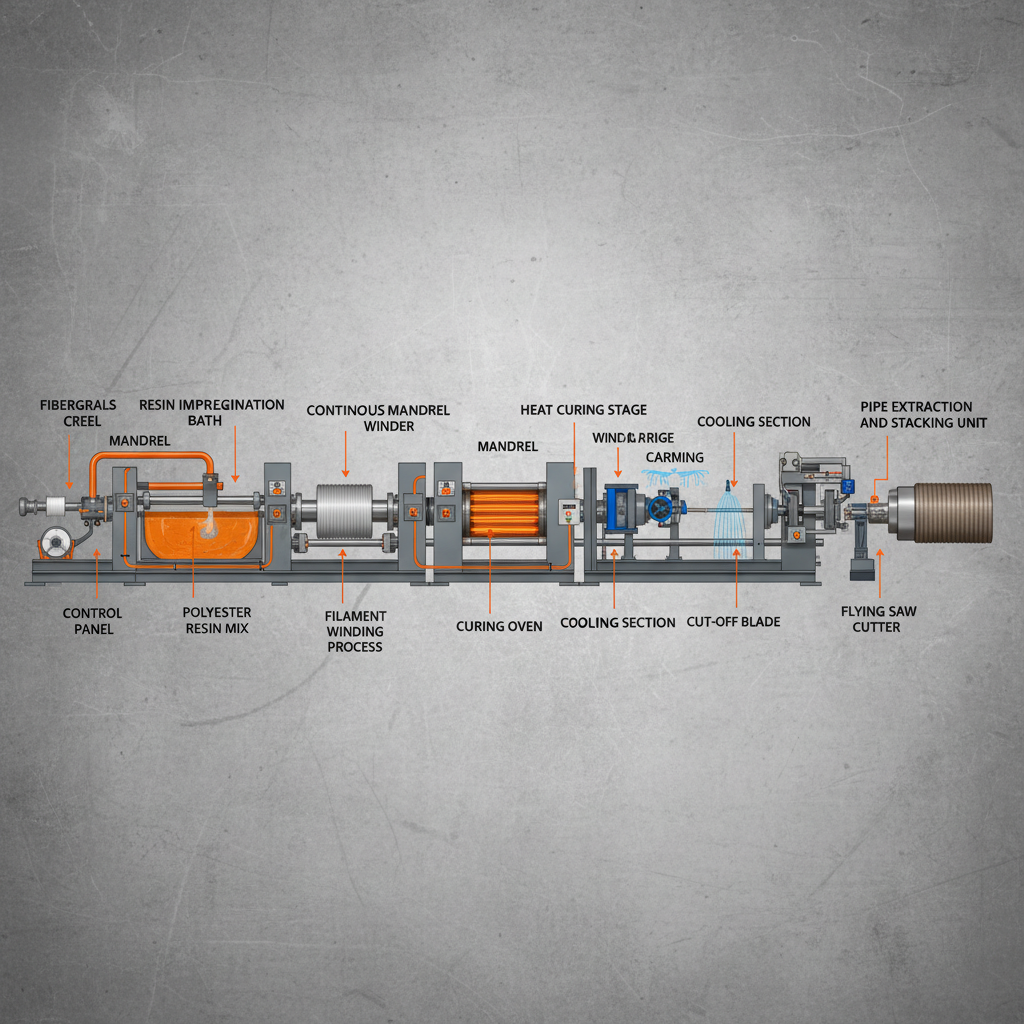
At its core, a grp pipe production line is a sophisticated assembly of machinery designed to combine glass fibers with a thermosetting resin matrix. This process, typically utilizing continuous filament winding, ensures that the fibers are oriented precisely to handle specific mechanical loads. The result is a composite pipe that possesses the strength of steel but the corrosion resistance of plastic.
Modern production lines are designed to address the humanitarian need for clean water and safe waste disposal. By automating the winding angle and resin dosage, manufacturers can create customized pipe walls that are optimized for either high internal pressure or high external soil loads. This flexibility makes GRP an ideal choice for everything from deep-sea oil pipelines to municipal sewage systems.
The synergy between the mechanical winding system and the curing oven is what defines the quality of the output. A well-calibrated grp pipe production line ensures a void-free laminate structure, which is critical for preventing leaks and structural failure over a 50-year service life. This reliability is why GRP is increasingly mandated in high-risk industrial zones.
Core Components of High-Efficiency Production
The heart of any professional grp pipe production line is the precision winding machine. This component manages the tension of the glass rovings and the speed of the rotating mandrel, ensuring that the fiber distribution is uniform across the entire length of the pipe. Without this precision, the pipe could suffer from wall thickness variations, leading to potential weak points.
Another critical factor is the Resin Impregnation System. In a high-performance grp pipe production line, this system must maintain a consistent resin-to-glass ratio. Advanced sensors and flow controllers prevent "resin-rich" or "resin-starved" areas, which is essential for maintaining the chemical resistance and impact strength required by international engineering standards.
Finally, the Curing and Extraction phase determines the final physical properties of the pipe. Modern lines utilize heated mandrels or infrared curing systems to accelerate the polymerization process. By optimizing the temperature curve, the grp pipe production line can significantly reduce cycle times, increasing daily output without compromising the structural integrity of the composite.
Industrial Performance and Scalability Metrics
When evaluating the effectiveness of a grp pipe production line, engineers look at key performance indicators (KPIs) such as winding speed, resin waste percentage, and energy consumption per meter of pipe. The ability to scale production from small-diameter conduits to massive industrial mains requires a modular approach to equipment design.
Scalability is not just about volume but also about versatility. A top-tier production line allows for the rapid changeover of mandrels and the adjustment of winding patterns to meet different pressure classes (PN ratings). This ensures that the manufacturer can serve diverse markets—from desalination plants to chemical refineries—using a single integrated facility.
Performance Comparison of GRP Pipe Production Line Methods
Global Applications and Regional Use Cases
The versatility of the grp pipe production line allows its products to be deployed in the most challenging environments on Earth. In the Middle East, GRP pipes are the gold standard for desalination plants where salt-water corrosion would destroy steel pipes within years. The lightweight nature of these pipes also facilitates installation in sandy terrains where heavy machinery access is limited.
In Southeast Asia and Africa, these production lines are supporting the rollout of large-scale irrigation networks. By utilizing GRP, regional governments can implement water transport systems that are immune to soil acidity and biological growth. Furthermore, in post-disaster reconstruction zones, the ability to quickly manufacture and joint GRP pipes ensures that clean water is restored to affected populations with minimal downtime.
Long-Term Value and Sustainability Benefits
The long-term economic value of investing in a grp pipe production line is found in the Total Cost of Ownership (TCO). While the initial setup cost may be higher than for traditional materials, the virtual elimination of maintenance and corrosion-related repairs creates massive savings over a 50-year window. This financial predictability is highly attractive to municipal planners and private industrial investors.
Beyond the balance sheet, there is a profound sustainability angle. GRP production has evolved to incorporate low-styrene resins and recyclable glass fibers, reducing the environmental footprint of the manufacturing process. Because GRP pipes do not leach chemicals into the soil and prevent leakage of hazardous industrial waste, they act as a protective barrier for local ecosystems.
Moreover, the energy efficiency gained during the installation phase—thanks to the lighter weight of GRP compared to concrete—reduces the carbon emissions associated with transportation and heavy lifting. This makes the grp pipe production line a key tool in the global transition toward "green" infrastructure.
Future Trends in GRP Manufacturing Technology
The next generation of the grp pipe production line is being shaped by the Industrial Internet of Things (IIoT) and AI-driven quality control. We are seeing the integration of real-time ultrasonic sensors that detect voids or delamination during the winding process, allowing for instant adjustments and zero-defect manufacturing.
Digital twins are also becoming common, where a virtual model of the grp pipe production line is used to simulate different resin chemistries and winding patterns before a single meter of pipe is produced. This reduces waste and accelerates the development of specialized pipes for extreme deep-sea or high-temperature applications.
Finally, the movement toward "bio-resins" is transforming the material science of GRP. Future production lines will likely support plant-based resins that maintain the same strength as petrochemical versions but offer a fully biodegradable or carbon-neutral lifecycle, further cementing GRP's role in a circular economy.
Comparison of GRP Production Technology Evolution
| Tech Generation |
Control System |
Material Efficiency |
Environmental Impact |
| Manual Era |
Mechanical Switches |
Low (High Waste) |
High Emissions |
| Semi-Auto |
Basic PLC |
Moderate |
Moderate |
| Full Auto |
Advanced PLC/CNC |
High Efficiency |
Controlled |
| Smart Line |
IIoT & AI Integration |
Optimized/Precision |
Low (Eco-Resins) |
| Hybrid-Fiber |
Adaptive Control |
Very High |
Circular Economy |
| Future-Gen |
Autonomous Learning |
Near-Zero Waste |
Carbon Neutral |
FAQS
Typically, pipes manufactured on a professional GRP production line have a design life of 50 to 100 years. Because GRP is inherently resistant to corrosion, oxidation, and chemical attacks, it does not suffer from the structural degradation seen in steel or concrete pipes, making it a superior choice for long-term municipal infrastructure.
The pressure rating (PN) is controlled by the winding angle of the glass fibers and the wall thickness. A high-end production line uses CNC-controlled carriages to wind fibers at specific helical angles—usually closer to 90 degrees for high-pressure requirements—ensuring the pipe can withstand internal hoop stress without bursting.
Yes, it is significantly more sustainable. GRP pipes require less energy to transport and install due to their weight. Furthermore, the transition toward low-styrene resins and the absence of toxic anti-corrosion coatings (common in steel pipes) reduce the overall environmental impact and prevent groundwater contamination.
The main challenges include maintaining a consistent resin-to-glass ratio and managing the curing time. If the resin is too thick, the pipe becomes brittle; if too thin, it loses strength. Expert operators use automated dosing systems and precise temperature controls to overcome these variables and ensure consistent quality.
Yes, most modern lines are designed with interchangeable mandrels. By switching the mandrel size and adjusting the software parameters for winding speed and fiber tension, a single production line can manufacture a wide range of diameters, from small industrial tubes to large-bore sewage mains.
Focus on the automation level, the precision of the winding carriage, and the after-sales support. Ensure the equipment complies with international standards like ASTM or ISO. Visiting a manufacturer's facility to see a live grp pipe production line in action is highly recommended to verify the build quality and operational efficiency.
Conclusion
The integration of a high-performance grp pipe production line represents a strategic leap for any manufacturer specializing in environmental and industrial equipment. By combining the structural resilience of glass fibers with the chemical stability of advanced resins, these production lines enable the creation of infrastructure that is not only durable but fundamentally sustainable. From the precision of the winding process to the scalability of the output, GRP technology addresses the critical global need for efficient, leak-proof, and long-lasting fluid transport systems.
Looking ahead, the evolution toward AI-integrated manufacturing and bio-based materials will further elevate the value proposition of GRP. For enterprises seeking to lead in the water treatment and chemical equipment sectors, investing in advanced composite production is no longer optional—it is a necessity for competitiveness and ecological responsibility. We invite you to explore our cutting-edge solutions and elevate your production capabilities. Visit our website: www.frpgrpmachine.com